Adarsha Kutumbam House Number 47 - AK 47 \[2026\]: Another Star-Driven Failure
Movie Review/Analysis:
Cast:
-Venkatesh as Chittibabu
-Srinidhi Shetty as Swarna, Chittibabu’s wife
-Yuvina Parthavi as Sampoorna, Chittibabu and Swarna’s daughter
-Raja Prajwal as Sharwa, Chittibabu and Swarna’s son
-Nara Rohith as Inspector Damodar Naidu
-Nivetha Pethuraj as Maala
-Rao…
Read moreShow less
Adarsha Kutumbam House Number 47 - AK 47 \[2026\]: Another Star-Driven Failure
Movie Review/Analysis:
Cast:
-Venkatesh as Chittibabu
-Srinidhi Shetty as Swarna, Chittibabu’s wife
-Yuvina Parthavi as Sampoorna, Chittibabu and Swarna’s daughter
-Raja Prajwal as Sharwa, Chittibabu and Swarna’s son
-Nara Rohith as Inspector Damodar Naidu
-Nivetha Pethuraj as Maala
-Rao Ramesh
Crew:
Director: Trivikram Srinivas
Story written by Trivikram Srinivas
Production (Banner): Haarika and Hassine Creations
The duration of Adarsha Kutumbam House Number 47 - AK 47 is 149 minutes
The Plot:
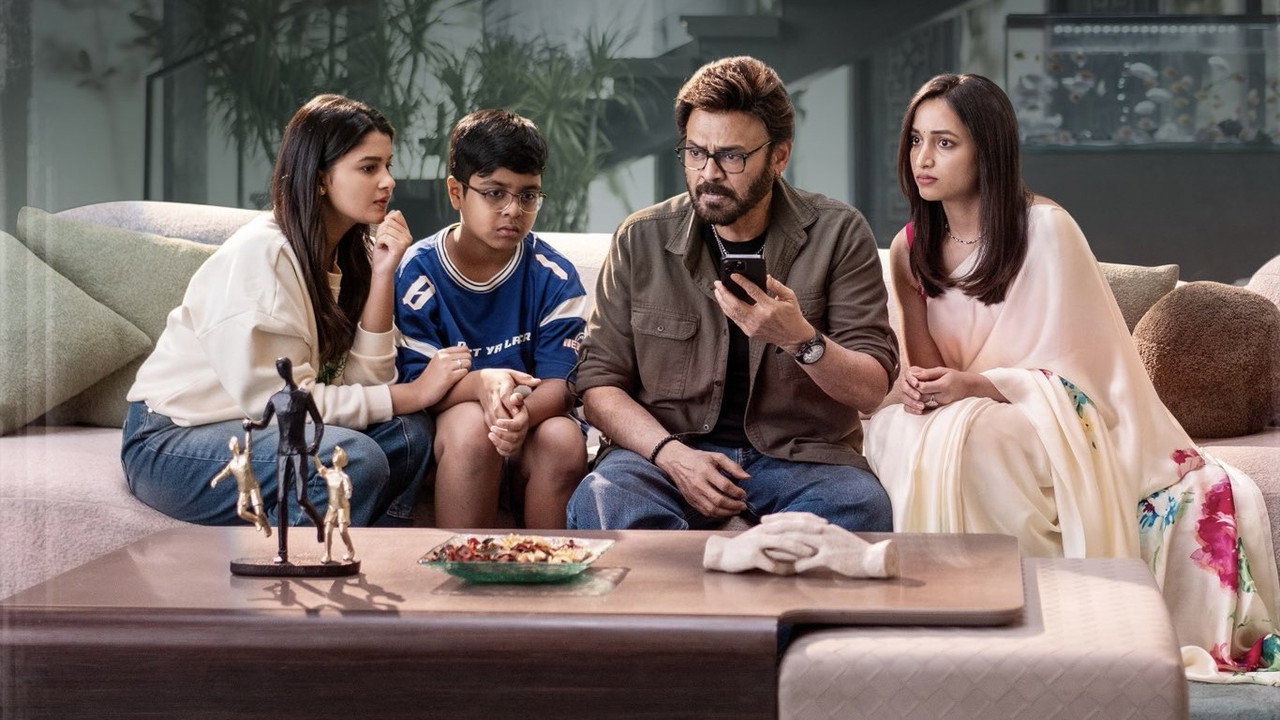
Chittibabu (Venkatesh), a middle-class man struggling with debts, wins a lottery of Rs. 100 Crores. He and his family which consists of Swarna (Srinidhi Shetty), Sampoorna (Yuvina Parthavi) and Sharwa (Raja Prajwal) then shifts to a luxurious villa, and this is publicized hugely and he becomes a celebrity. but a gang from Bihar, who robs and kills rich people targets Chittibabu and his family. They take jobs in his house, and on the day, he withdraws that money, they plan to take the money and kill them. But Chittibabu and his family fight with them and kill them all, except one, who managed to hide in a tempo traveller. Chittibabu and his family is taken to Police station, here we get to know that they were different criminals with different names who were tasked to pretend like a family to catch the criminals of the Bihar gang and that 100 Crore lottery money was fake. Whereabouts of the killed people are asked, but Chittibabu and his family maintain innocence saying that they don’t know anything and the gang did not arrive. Police see through it, but lets them go, hoping that the Bihar gang would come searching for them, and they would catch the gang or the criminals would be dead. The Bihar gang leader comes and tries to attack in the mall, but Chittibabu and his family manage to escape. On the day, where they were supposed to be attacked in their house, they leave to the original place where the Bihar gang is located. The gang and the Police are also in same train. A fight happens where the Bihar gang is killed. Chittibabu takes the money from their leaders and settles with them as they become family. It is revealed that Chittibabu killed the Bihar gang people as revenge for killing a judge (Nassar).
Main Review/Analysis:
Adarsha Kutumbam House Number 47 - AK 47 is a film that released in theater today, and I watched it today, and let me be honest, I did not like this film.
Positives:
1. Venkatesh and Srinidhi Shetty deliver solid performances
2. The screenplay has cause-and-effect progression
Negatives:
1. The story does not have depth nor is it genre appropriate. On the top of the surface, it may look like an innovative story but when dissected deeply, the problem is the film is not clear in its story whether it wants to be a comedy film, a heist thriller film or a vigilante film
2. While the humour may look cool on a surface level, which may make someone falsely assume that the screenplay is gripping and sustains interest but in reality, it is a sparsely structured poor script. The screenplay does not have grip.
3. The character development is very poor
4. The film does not justify what exactly does the judge mean to Chittibabu
5. The writing focuses on elevating the star rather than the characters
6. The fighting choreography is poor
7. The picturization is very poor
8. The songs are not good
9. The background score is very poor
10. The atmosphere is not good
11. The dialogues elevate the star rather than serving characterization
12. The final emotional payoff is missing
Why the story appears to be innovative on the surface:
On paper, the film has several elements that suggest an unconventional story like:
i). A middle-class family suddenly becomes wealthy after winning ₹100 crore.
ii). A dangerous gang infiltrates their luxurious house by posing as domestic employees.
iii). The supposed family members fight back and eliminate most of the attackers.
iv). A major revelation establishes that the family is actually a group of criminals pretending to be related.
v). The lottery itself is revealed to be fabricated as part of a larger operation.
vi). The narrative eventually reveals Chittibabu's personal revenge motive involving a murdered judge.
These are not inherently weak ideas. In fact, the revelation that an apparently ordinary family is actually composed of criminals creates interesting possibilities.
For example, the film could explore the conflict between their fabricated familial identities and their real personalities.
Their individual criminal backgrounds could influence how they respond to danger. But in the film they respond in a similar manner. The fake lottery could become the centre of a tightly constructed thriller involving deception, surveillance, and counter-deception.
However, the film's character development and sparsely structured script, these possibilities are not meaningfully explored or explored just at a surface level. The film introduces potentially interesting ideas but does not extract sufficient dramatic substance from them. That is why the story initially appears to be innovative without actually possessing depth.
Why the story lacks depth:
Depth does not necessarily require philosophical themes, complicated story, or serious subject matter.
Even a straightforward commercial entertainer can possess considerable depth when its central conflict, characters, motivations, and relationships are developed convincingly.
In this case, there are three major areas where greater depth could have emerged:
a). The fake family is an interesting concept without sufficient characterization:
The film's central revelation is that Chittibabu, Swarna, Sampoorna, and Sharwa are not actually a family. They are criminals assigned to impersonate one. This revelation changes the audience's understanding of their relationships. However, a potentially important question arises:
What does pretending to be a family mean to four individuals who were previously unrelated?
The film could have explored how they negotiate their artificial relationships, whether they distrust one another, and how their experiences gradually transform their attachment into genuine familial affection. The character development is very poor.
Consequently, the eventual decision to remain together as a family risks becoming merely a convenient conclusion rather than the culmination of an emotional journey. The distinction is significant:
Becoming a family is an event. Developing into a family is a story.
The former can be communicated through a single scene. The latter requires characterization, interactions, conflict, and progression. The film emphasizes the event without sufficiently developing the journey.
b). Chittibabu’s revenge lacks an established emotional foundation:
The revelation that Chittibabu kills the Bihar gang members to avenge a murdered judge is potentially important. It gives his actions a personal motive beyond the operation involving the fake family. But there is a fundamental weakness: the film does not adequately explain what the judge meant to Chittibabu.
Was the judge someone who transformed Chittibabu's life? Did he protect Chittibabu? Was there a meaningful relationship between them? These are possibilities the film could have explored. The point is that a revenge narrative requires some understanding of why the loss matters to the protagonist.
Simply establishing that somebody was murdered and the protagonist wants revenge supplies a motivation at the level of narrative mechanics. It does not automatically create depth.
Therefore, the final revelation might answer the question, why did Chittibabu kill them? without adequately answering, why should the audience feel the significance of his revenge?
c). The central conflict is more mechanical than psychological:
The story contains several confrontations between Chittibabu's group and the Bihar gang. However, the narrative is primarily organized around external events: infiltration, fighting, escaping, pursuit, and killing.
The characters' internal conflicts does not receive comparable development.
The story could have used questions of loyalty, mistrust, guilt, identity, or revenge to deepen those external confrontations. Instead, the film relies extensively on star elevation and action-oriented situations. This makes the narrative event-driven without necessarily making it character-driven.
Why the film struggles as a comedy:
A comedy does not require a complex story. However, its premise, characters, and situations should generate humour that remains engaging. The fake-family setup could have created a strong situational comedy. Let us imagine the opportunities created by four criminals with different personalities being required to behave like an ordinary household. Their contrasting habits, improvised relationships, and attempts to maintain their cover could create humour naturally. However, the humour in the film is just at a superficial level.
My main objection is that the comedic moments do not compensate for the lack of structural density in the script. That distinction matters. An amusing dialogue or entertaining situation may provide immediate enjoyment, but it does not necessarily advance the story or deepen the characters.
When comedy is integrated into the screenplay, the humour can arise from the characters' decisions and produce consequences that influence later events. In contrast, when comedy functions mainly as a collection of entertaining moments, it interrupts the narrative rather than enriching it. My criticism is not that the film contains comedy, rather it is that the comedy fails to provide sufficient narrative substance.
Why the film struggles as a heist thriller:
A heist thriller typically derives much of its appeal from planning, deception, competing objectives, reversals, and the uncertainty surrounding success or failure.
The film initially appears to have the ingredients of such a thriller. The Bihar gang infiltrates the household, poses as employees, and plans to steal the supposed lottery fortune. Meanwhile, the apparent targets turn out to be criminals themselves. This creates the possibility of an engaging contest between two groups employing deception. However, the ₹100 crore lottery is revealed to be fake. That revelation is not inherently a weakness. It could strengthen the narrative if the deception were developed through carefully established clues and meaningful reversals. The problem, is that the screenplay lacks grip despite having cause-and-effect progression. Once the household confrontation has occurred, the narrative shifts into police involvement, pursuit, a mall attack, and eventually a train confrontation. These events are causally connected, but the original heist premise no longer appears to be the principal source of suspense. The storyline increasingly becomes a succession of confrontations. Consequently, the heist serves as a narrative hook rather than remaining a fully developed dramatic mechanism. A heist thriller needs more than criminals, money, and a robbery plan. It needs sustained tension generated by the execution and consequences of that plan. This sustained tension is missing in the film.
Why the film struggles as a vigilante revenge drama
The film also contains the ingredients of a vigilante narrative. Chittibabu kills members of a dangerous criminal gang and is eventually revealed to have a personal revenge motive. But vigilante stories require more than the elimination of criminals. They typically derive their dramatic force from some combination of personal loss, moral conviction, injustice, institutional failure, and the consequences of taking justice into one's own hands. In this case, the judge's murder could have provided that foundation. However, the judge’s relationship with Chittibabu is insufficiently justified becomes particularly damaging to the vigilante dimension. The film presents the result of Chittibabu's revenge without adequately developing its emotional origins. Furthermore, the police allowing the apparent family to leave in the hope that further confrontations will eliminate criminals raises potentially interesting questions about the relationship between law enforcement and extrajudicial violence. The story of the film does not explore these questions in depth. As a result, the revenge motive functions primarily as a concluding explanation for Chittibabu's actions. The film uses revenge to justify the climax rather than building the climax upon a strongly developed revenge narrative.
The Fundamental Problem of the Film: Genre Elements without Genre Integration
The film appears to follow three overlapping narrative directions.
i). Family Comedy: A supposedly ordinary family becomes rich and adjusts to luxurious circumstances.
ii). Heist/crime thriller: An infiltrating gang attempts a robbery, and the fake family's criminal identities are exposed.
iii). Vigilante revenge drama: Chittibabu's ultimate motivation is revealed to be revenge for the murder of a judge.
My central objection: The transitions introduce new dimensions of the story without sufficiently developing or integrating the preceding ones.
The problem is not that the film begins as a comedy and eventually reveals itself to be a revenge drama.
Such a transition can be highly effective when earlier scenes establish characters, relationships, or conflicts that acquire greater meaning after the revelation. Instead, the different genres remain relatively disconnected. The comedy does not sufficiently develop the fake family into convincing characters. The crime-thriller elements do not sustain screenplay grip.
The revenge dimension does not provide a final emotional payoff. Thus, each genre introduces a different expectation, but none is sufficiently developed to compensate for the others.
Why the twist is not equivalent to depth:
A major revelation can change the audience's understanding of a story without necessarily enriching it. In Adarsha Kutumbam House Number 47 - AK 47, the fake-family revelation is an important narrative twist. The personal revenge revelation supplies another surprise. But there is a difference between a twist that merely changes the facts and a twist that gives earlier events deeper meaning. A strong twist encourages the audience to reconsider previous scenes because those scenes acquire new psychological, thematic, or dramatic significance.
An underdeveloped twist primarily provides additional information. The weak characterization and the judge's unexplained importance suggest that the revelations function more as shock value or narrative surprises han as emotionally rewarding reinterpretations of the story. The film has narrative complexity in its premise but insufficient dramatic depth in its execution.
The Reconstructed Plot:
The film opens with a robbery in Hyderabad. A wealthy businessman and his family are murdered after a group of criminals infiltrates their house as domestic workers. The gang escapes with Rs. 18 crore in cash and valuables. Inspector Damodar Naidu (Nara Rohith) investigates the incident and discovers that it resembles several robberies committed by a criminal organization originating in Bihar. The gang uses a distinctive method. First, it identifies a family that has recently acquired considerable wealth. Its members then enter the house through employment agencies, establish the family's routines, and determine the location of its money. Finally, they murder the occupants, steal their wealth and disappear. Damodar learns that Raghav Sinha (Ravi Mariya) is preparing another operation in Hyderabad. However, his investigation has stalled because Raghav uses intermediaries and has compromised several local police officials. Chittibabu (Venkatesh) now runs a modest accounting office. He lives alone, avoids unnecessary attention and occasionally visits the memorial of Judge Narayana Rao (Nassar).
Through a flashback, we learn that Chittibabu once discovered financial irregularities involving a criminal syndicate. When he attempted to expose them, he was framed for murder. Judge Narayana Rao refused to accept fabricated evidence, ordered further investigation and eventually ensured Chittibabu's acquittal. Afterwards, the judge helped Chittibabu find legitimate work. Their relationship gradually developed into one of affection and mutual respect. The judge treated Chittibabu as a son, while Chittibabu considered him the father he had never known. Three years later, Narayana Rao was murdered while investigating an organized criminal network. Chittibabu has never forgiven himself because he believes the judge's association with him contributed to the tragedy.
Damodar approaches Chittibabu with evidence suggesting that Raghav Sinha ordered the judge's murder. He proposes an undercover operation. A fabricated lottery victory will attract Raghav's attention. A team of former criminals will pose as Chittibabu's family, while the police monitor the gang and gather evidence. Chittibabu initially refuses. But Damodar shows him a photograph linking Raghav to one of the judge's suspected killers. Chittibabu agrees on one condition: he wants to confront Raghav personally. Damodar refuses to authorize revenge and makes it clear that the objective is arrest and prosecution.
Swarna (Srinidhi Shetty), Sampoorna (Yuvina Parthavi) and Sharwa (Raja Prajwal) are recruited because each has knowledge or skills useful to the operation and agrees to cooperate in exchange for lawful consideration in their pending cases. Their first meeting with Chittibabu is disastrous. Swarna refuses to accept his authority. Sampoorna mocks Sharwa's lack of discipline. Sharwa objects to being treated like a child. They struggle even to remember their fabricated family history. Damodar warns them that a single inconsistency could expose the entire operation. The family undergoes training, during which they learn each other's habits and rehearse their relationships. Sharwa repeatedly calls Chittibabu by his real name in public. Sampoorna constructs an elaborate fictional family history that Swarna cannot remember. Chittibabu discovers that controlling three independent criminals is considerably harder than deceiving a financial auditor.
However, these mistakes have consequences. Damodar realizes that they are not yet prepared for the operation and extends their training. When they completely learn each other’s habits, Chittibabu publicly receives a fabricated Rs. 100 crore lottery prize. The event is widely publicized. Raghav's intelligence network notices the announcement. The family moves into a luxurious villa, unaware that Raghav has already begun investigating them. Raghav dispatches three members of his gang to infiltrate the household. One poses as a cook, another as a driver, and the third as a security assistant. Chittibabu recognizes suspicious inconsistencies in their employment records but deliberately hires them under Damodar's supervision. Maala enters the household as an additional domestic employee, secretly coordinating with the police. The Bihar gang is pretending to serve an ordinary wealthy family.
The supposed wealthy family is pretending not to know that its servants are criminals. During a family dinner, the cook attempts to discover the location of the lottery money.
Swarna deliberately supplies misleading information, but Sharwa almost contradicts her. Chittibabu improvises an explanation, saving their cover. Later, the driver searches Chittibabu's office while the family is away. Sampoorna detects the intrusion using hidden sensors.
However, her attempt to remotely lock the room alerts the intruder to the possibility of surveillance. Raghav consequently orders his men to investigate the family more carefully.Every success now creates a new complication. Meanwhile, their relationships gradually develop. Sampoorna receives a threatening call from a former associate connected with her financial crimes. Chittibabu quietly intervenes and protects her without demanding anything in return. For the first time, Sampoorna experiences paternal concern that is not conditional on obedience or usefulness. Sharwa damages an expensive car while secretly pursuing one of the gang's contacts. He expects Chittibabu to abandon him. Instead, Chittibabu rebukes him for risking everyone's lives but takes responsibility for protecting him from the gang. Swarna begins to notice that Chittibabu treats their fabricated relationships with unusual seriousness. She confronts him. He reveals that Judge Narayana Rao once told him that a family is not defined merely by the people who are born together, but also by the people who refuse to abandon one another. Maala discovers that Raghav has identified the fake lottery as suspicious. Rather than withdrawing, he decides to proceed because he believes Chittibabu possesses valuable financial documents connected to Narayana Rao. The gang's real objective is now revealed to be larger than the robbery. Narayana Rao had gathered evidence of a financial network through which Raghav laundered proceeds from robberies and murders. Raghav suspects that Chittibabu possesses a surviving copy of those records. Unknown to Damodar, Chittibabu does possess part of the judge's files. He has concealed this fact because he fears that corrupt officials could destroy the evidence. Raghav unexpectedly advances the robbery. The infiltrators sabotage the villa's security and attempt to capture Chittibabu. The fake family fights back. However, their lack of coordination initially creates serious danger. Sharwa is injured while protecting Sampoorna. Swarna prevents an attacker from reaching Chittibabu. Maala manages to alert Damodar, but a compromised police officer deliberately delays reinforcements. The family survives by using the house's layout, previously established security measures and their individual skills. Two gang members are arrested, while another escapes. Before fleeing, the surviving attacker reveals that Raghav already knows the family's true identities. He also claims to know where Narayana Rao's remaining evidence is hidden. Chittibabu realizes that Raghav has been manipulating the operation from the beginning. The police interrogate the captured gang members. They discover that Raghav deliberately leaked information to Damodar, anticipating the undercover operation. His objective was to force Chittibabu into the open and recover Narayana Rao's evidence. The family was not simply bait for Raghav. Swarna confronts Chittibabu about his concealment of the judge's evidence. He admits that Narayana Rao had asked him to preserve the records until they could be transferred to a trustworthy investigating authority. But Chittibabu made a mistake. He contacted a police official whom he believed to be honest. That official secretly informed Raghav. Within days, the judge was murdered. Chittibabu has spent three years believing that his decision caused the death of the man who saved him.
Swarna challenges him, arguing that killing Raghav will not undo the judge's death. Chittibabu insists that the law failed Narayana Rao. Raghav had also been using the family as bait to locate the missing documents. Damodar discovers that Chittibabu concealed evidence from the investigation. He suspends the operation and orders the team into protective custody. Swarna is furious because Chittibabu endangered them without revealing the complete truth. Sampoorna believes that the affection she received was merely part of another deception. Sharwa accuses Chittibabu of treating them as expendable participants in his revenge. For the first time, the family separates. Raghav abducts Maala after discovering her identity. He demands the remaining evidence in exchange for her life. Damodar prepares a rescue operation, but a corrupt officer leaks the plan. Sampoorna intercepts the communication and discovers the betrayal. She approaches Swarna and Sharwa. They realize that Chittibabu had genuinely protected them, even though he had also made serious mistakes. The three decide to help Damodar rescue Maala.
However, their decision is no longer based on the benefits promised for cooperating with the police. They choose to act because they care about one another. When they approach Chittibabu, Swarna tells him that they will help only if he abandons his intention to murder Raghav. Chittibabu agrees. For the first time, he accepts that his responsibility towards the living matters more than his desire for revenge.
Raghav plans to escape on a freight train carrying containers used to transport stolen goods and laundered assets. Damodar arranges an operation at the railway yard. The family participates with defined responsibilities. Sampoorna identifies the containers through electronic shipping records. Sharwa intercepts the gang's escape vehicles. Swarna infiltrates the yard using a previously established criminal contact. Chittibabu and Damodar enter the freight loading area to rescue Maala and obtain the evidence. Chittibabu finally corners Raghav.
Raghav admits that he ordered Narayan Rao's murder because the judge refused to abandon the investigation. He also reveals that Chittibabu's misplaced trust in the corrupt police officer helped expose the judge's location. This confirms Chittibabu's deepest fear. A brutal confrontation follows. Chittibabu defeats Raghav and prepares to kill him. But he remembers Narayana Rao's belief that justice must never become an excuse for personal vengeance. At that moment, Raghav attempts to shoot Swarna. Chittibabu moves to protect her. Damodar disarms Raghav, and Swarna helps restrain him. Raghav is arrested alive. The evidence is recovered and Maala is rescued. The recovered documents expose Raghav's criminal network and the officials who protected him. Damodar ensures that the evidence is transferred through multiple independently monitored channels to prevent its destruction. A judicial investigation is initiated. The surviving criminals are prosecuted, and the people responsible for Narayana Rao's murder face trial. The resolution reinforces the judge's commitment to justice instead of contradicting it through an act of personal revenge. Several months later, Chittibabu, Swarna, Sampoorna and Sharwa meet at the courthouse. Their cooperation has been considered in their respective legal proceedings, but they remain accountable for their earlier crimes. Damodar informs them that the undercover operation is officially concluded. Their legal identities have been restored. They no longer need to pretend to be a family. Chittibabu tells the others that they are free to return to their individual lives. Sampoorna quietly asks whether she can continue living with him. Sharwa jokingly says that somebody needs to prevent Chittibabu from becoming too serious. Swarna reminds Chittibabu that he still owes her an apology for keeping the truth about the judge's evidence from her. Chittibabu apologizes sincerely. They decide to share a home and build an honest life together. They visit Narayana Rao's memorial. Chittibabu places a photograph of the four of them beside the judge's portrait. He says that Narayana Rao once gave him a second chance at life. Now, through the people he has come to love, he has finally found a reason to live that life. The four return home together, and the name of that house is 47.
How does the reconstructed story correct the original film’s weaknesses:
The original struggles to determine whether it is primarily a family comedy, a heist thriller, or a vigilante revenge film.
My reconstruction resolves this by establishing the film as a crime thriller with family drama, situational comedy, and a revenge conflict integrated into its central narrative. The reconstruction does not eliminate the three genres. Instead, it establishes a hierarchy. The crime thriller supplies the principal narrative framework. The family drama provides emotional substance, while comedy and revenge influence how the central conflict develops. Consequently, the genre elements support one another rather than competing for the film's identity. The reconstructed film creates genuine depth because in the original film, four unrelated criminals impersonate a family, defeat a gang, and eventually decide to remain together. However, the emotional process through which they become attached to one another is insufficiently developed.
The reconstructed version introduces three interconnected dramatic questions:
i). Can four criminals who initially distrust one another develop genuine familial affection?
ii). Can Chittibabu obtain justice for Narayana Rao without surrendering to personal vengeance?
iii). Can individuals with criminal histories earn a second chance without escaping accountability?
These questions give the narrative greater substance.
For example, Chittibabu's decision to protect Sampoorna from a threatening former associate becomes significant because it changes her understanding of him. He is no longer merely the man assigned to pretend to be her father. Similarly, Sharwa's reckless pursuit of a gang contact produces consequences. Chittibabu reprimands him but also protects him, demonstrating paternal responsibility. These situations are not merely emotional episodes. They establish relationships that influence the characters' later decisions. The reconstruction therefore develops the central idea that family is created through responsibility, trust, sacrifice, and sustained affection rather than simply through an assigned identity. The reconstructed film has a very good gripping screenplay and this is perhaps the most important screenplay improvement.
My reconstructed story does not merely contain numerous incidents. Its incidents serve multiple dramatic functions, and their consequences influence subsequent developments.
For example a single incident generates several consequences:
1. Sampoorna detects an intruder in Chittibabu’s office
2. She activates the remote locking system
3. The intruder suspects surveillance
4. Raghav orders a deeper investigation of the family
5. The undercover operation becomes more dangerous
This short sequence simultaneously demonstrates Sampoorna's intelligence, establishes the effectiveness and limitations of the surveillance system, increases suspicion, and escalates the central conflict.
The original film possesses cause-and-effect progression. But causality alone does not guarantee structural density or screenplay grip. The reconstruction improves upon that by making individual scenes perform several interconnected functions. Another example is Chittibabu's concealment of the judge's documents. It simultaneously creates a tactical weakness, damages his relationship with the family, reveals his guilt over Narayana Rao's death, and enables Raghav to manipulate the operation. In my reconstructed film, Chittibabu becomes a properly developed active protagonist. In the original film, Chittibabu participates in confrontations and ultimately achieves his revenge. However, his emotional motivation and the significance of the murdered judge remain inadequately established. The reconstruction gives him a history, a motivation, a weakness, and a meaningful transformation. The reconstruction particularly benefits from making Chittibabu responsible for a consequential mistake. His misplaced trust in a corrupt police officer helps expose Narayana Rao to danger. His subsequent concealment of the evidence damages the undercover operation. Thus, Chittibabu is not a star figure who merely defeats villains. He is an active individual whose choices have consequences. His eventual victory comes not simply through physical strength, but through character development.
I have made the Judge and assigned him the name Narayana Rao who becomes central to the story because my original criticism that the film fails to justify what the judge means to Chittibabu is addressed directly.
The reconstruction establishes that Narayana Rao:
1. Refused to accept fabricated evidence against Chittibabu
2. Ensured that the investigation leading to Chittibabu’s acquittal was conducted properly
3. Helped him obtain legitimate employment.
4. Developed a father-son relationship with him.
5. Taught him that family involves refusing to abandon people.
6. Believed that justice should never become an excuse for personal revenge.
These details transform the judge from a convenient revenge justification into a character whose influence extends throughout the narrative. His philosophy shapes Chittibabu's developing attachment to the fake family. His murder creates the protagonist's guilt. His evidence motivates Raghav's criminal activities. His belief in justice determines Chittibabu's final moral choice. Most importantly, Narayana Rao remains dramatically relevant even after his death. The judge's influence is no longer confined to explaining the climax. It becomes one of the foundations of the entire story.
In my reconstructed story, the four fake family members receive meaningful characterization. In the original, the revelation that the family members are criminals changes the facts of the story, but the characters' relationships do not undergo sufficient development.
My reconstruction establishes different attitudes, skills, weaknesses, and emotional needs. The reconstruction also makes their disagreements essential to the drama. When Chittibabu's deception is exposed, Swarna, Sampoorna, and Sharwa do not simply forgive him. They feel betrayed, and their separation becomes a significant setback. Their eventual decision to return therefore carries emotional meaning because it is voluntary. Initially, they cooperate for legal consideration. Eventually, they cooperate because they genuinely care about one another. This distinction gives their transformation credibility. The original's superficial humour is replaced by comedy originating from character differences and the practical difficulties of maintaining false identities. For instance, Sharwa repeatedly addresses Chittibabu by his real name in public. Sampoorna invents an elaborate family history that Swarna cannot remember. Chittibabu struggles to control three independent individuals who refuse to behave like an obedient household. These situations have an immediate humorous dimension, but they also serve the narrative. Their inability to maintain consistent identities forces Damodar to extend the training process. The comedy exposes the group's lack of coordination, which later becomes important when they face a genuine criminal threat. Therefore, the humour is not merely inserted to entertain the audience between important scenes.
It grows out of the premise and produces consequences within the screenplay. The precise success of the humour would still depend on dialogue, performances, and comic timing, which I think actors like Venkatesh, Srinidhi Shetty etc would pull it off well and my reconstructed story gives it a stronger foundation to showcase their skills to the audience.
The heist thriller now contains deception, counter-deception, and reversals. The original introduces a potentially suspenseful situation: criminals infiltrating a rich household, unaware that its occupants are also criminals. However, the story does not sufficiently exploit this dual deception. The reconstruction takes that idea much further where the competing operations are:
Damodar’s operation:
i). Create a fake wealthy household to lure and and expose Raghav’s gang
ii). Secret advantage: The family knows that its domestic employees are criminals.
Raghav’s operation:
i). Infiltrate the household to recover Narayana Rao's hidden financial evidence.
ii). Secret advantage: Raghav has anticipated the police operation and compromised officials.
The central dramatic reversal is: Both sides believe they are manipulating the other, while neither fully understands the other's knowledge.
Now this establishes a much stronger suspense mechanism.
The audience can follow who knows what, who is concealing information, and how each side reacts when its plans are disrupted. The robbery is also given a second objective: recovering the judge's evidence. This makes the financial crime story and the revenge story of the same conflict. Unlike the original, the heist premise does not become irrelevant once the initial household confrontation concludes.
The screenplay gains grip through escalating complications:
My reconstruction improves the potential for sustained interest because each major development alters the characters' situation.
The progression is particularly effective because:
i). The bait is established: The fabricated lottery draws Raghav's attention.
ii). The gang infiltrates the villa: The family must maintain its identities while monitoring the intruders.
iii). The deception begins to fail: The intruders discover signs of surveillance.
iv). The gang’s objective changes: Raghav suspects that Chittibabu possesses Narayana Rao's evidence.
v). The household operation collapses: The gang attacks earlier than anticipated, and corrupt officials obstruct reinforcements.
vi). A major reversal occurs: Raghav anticipated the undercover operation and manipulated Chittibabu into exposing himself.
vii). The central relationships fracture: Chittibabu's concealment causes the family to separate.
viii). The antagonist escalates the conflict: Maala is abducted, forcing the characters into another dangerous operation.
ix). The protagonists reunite through choice: The family returns to rescue Maala, provided Chittibabu abandons his revenge objective.
x). The final confrontation resolves both conflicts: Raghav is arrested, the evidence survives, and Chittibabu chooses justice over vengeance.
This structure creates rising danger, reversals, and emotional consequences. However, structural improvement does not automatically establish that a finished screenplay would remain gripping. Trivikram would still need to avoid excessive exposition, repetitive confrontations, and unnecessary prolongation of the undercover training. Nevertheless, the reconstructed story contains considerably stronger material for sustained suspense.
In the original film, my criticism was the writing emphasized Venkatesh’s star image rather than developing Chittibabu as a character. The reconstructed story corrects the underlying writing problem. Chittibabu makes mistakes, experiences guilt, conceals information, suffers rejection, and must ultimately change his behaviour. Even in the climax, his victory is not defined by defeating Raghav physically. His most significant action is deciding not to murder him. Swarna and Damodar also contribute directly to Raghav's capture, preventing the climax from reducing every other character to a passive observer. It also allows the established strengths of Venkatesh and Srinidhi Shetty, which I had identified as a positive in the original film itself.
The original ends with the criminals becoming a family, but the necessary emotional progression is underdeveloped. My reconstructed ending works better because it resolves three dramatic journeys simultaneously.
i). First: Chittibabu’s revenge journey: He defeats Raghav but chooses arrest and prosecution instead of killing him. This fulfils Narayana Rao's belief in justice.
ii). Second: the fake family's relationship journey: The four members no longer have any operational obligation to remain together. Their decision to live together becomes a genuine expression of affection.
iii). Third: Their accountability journey: Cooperation with the police is considered in their legal proceedings, but their earlier crimes are not simply forgotten. They are offered the possibility of rebuilding their lives while remaining accountable.
The final visit to Narayana Rao's memorial brings these threads together.
Chittibabu places a photograph of the four of them beside the judge's portrait. The man who once gave him a second chance is now indirectly responsible for the family he has found.
This is an emotional conclusion generated by the preceding story, rather than an ending that merely informs the audience that the characters have become a family.
The title Adarsha Kutumbam House Number 47 - AK 47 also gains thematic importance. The house is no longer merely a location used for the undercover operation; it becomes a symbol of their chosen family and new beginning.
Note: For the reconstructed story, I have given few characters their own names, or edited a few.
Second note: The reconstructed story addresses the gaps that existed in story and screenplay. Direction, music, dialogues etc would determine whether these improvements translate into a genuinely good film.
My Rating: ½☆☆☆☆
My Verdict: Horrible
By: Vashista Bhat
 FILM
 FILM
 FILM
 FILM
 FILM
 FILM
 FILM
 FILM
 FILM
 FILM
 VenkateshChittibabu
 Srinidhi ShettySwarna
 Nara RohithCast member
 Nivetha PethurajCast member
 Yuvina ParthaviSampoorna
 Rao RameshCast member
 SatyaCast member
 BrahmajiCast member
 Udaybir SandhuCast member
 Vennela KishoreCast member
 Raghu BabuCast member